Tuesday, January 22, 2019

Putting a Little English on It

Novel Spaces is in its 10th year! Over the coming months we'll be featuring some of the most popular posts from our archives. This one was first published March 3, 2013.


By Kevin Killiany

My wife, who grew up in rural coastal South Carolina in the 1960s, was one of four black students to integrate a white high school. She has lived through danger and repression I can only imperfectly imagine. I'm something of an aberration in her portfolio, which documents a lifetime of involvement in and championing of African American culture. One thing that makes her angry is novels by black writers in which educated, professional, upper-middle-class black characters are familiar with the drug culture, routinely drop the f-bomb and n-bomb in conversation, and have a casual attitude about sex and marriage. She gets particularly incensed at the depiction of black men as dogs.

A writer at a recent workshop presented a story set in a working-class urban community. The writer and the characters were black and, though the writer did not, all of her characters spoke in a cursing, slang-filled argot in dialog replete with phonetic spellings. A white member of the workshop admitted she'd had difficulty following some of the conversations and suggested the writer's work would be more accessible if she employed standard usage with only a few bits of slang. The writer questioned whether telling her to make her characters sound more white was a valid criticism. I cited the works of Caribbean writers here in Novel Spaces (with directions to their respective websites) as examples of incorporating elements of a culture authentically but in a way that was accessible to the widest range of readers and the conversation ended soon thereafter.

My native tongue is Southern English. This means that in the spoken language I know that 'child' rhymes with 'while'; that there's no need to enunciate the silent G at the end of words like readin, writin, children, or singin; and that an R following a vowel is softened (not eliminated, as some impersonators would have you believe). As a Southern writer I know the language is enriched by whimsical usage and the employment of words not currently in vogue; that initial articles are often superfluous; and that one should trust one's listeners and readers are intelligent enough to apprehend the occasional unspoken verb or subject. However, I'm also aware that many folk outside the South assume that Southern usage implies the inability to master any other and may be evidence of limited intellectual acuity. If not inbreeding. More troubling to me is that for many people of colors other than beige a white person who speaks with a Southern accent is suspected of being a closet klansman, or to at least harbor prejudicial tendencies. (And I know from personal experience that a white writer who depicts black Southerners as speaking with the same Southern accent he speaks with can find himself vilified as a racist.) With that in mind, I limit the dropped G in my characters' conversations to just often enough to establish locale and at no time call attention to the fact 'mild' and 'mile' are homophones. While I do exercise my cultural predilection for offbeat word choice and atypical sentence structure, I make a conscious effort to keep things simple enough for English majors to follow.

The assumption writing in dialect implies racism is not a new development; and it's not exclusively directed at white writers. I know my love for Zora Neale Hurston is on record somewhere—several someheres. According to Google Maps the Maitland, Florida, house I grew up in is four-point-three miles from the Zora Neale Hurston Museum in Eatonville, Florida. Never met her. I discovered her in college, and through her the Harlem Renaissance, but she had passed away the winter before the summer I became a reader. She did not, as I've seen reported elsewhere, starve to death in a homeless shelter. She was working as a librarian in Fort Pierce, FL, when she died of a stroke. However, it is true that due to lack of funds she was buried without a headstone. And the reason she had to work as a librarian and died too poor for a headstone is the direct result of the way she wrote. Or, more accurately, how her writing was perceived by others.

Hurston was an anthropologist by training – as in had degrees from Howard and Columbia – and a dedicated folklorist. She traveled to remote southern communities and as far afield as Haiti collecting legends and folk tales and recording them before they were lost to history. As a trained folklorist she wrote phonetically – because how a language is spoken shapes the sound and rhythm of the words. In other words, she wrote in dialect for legitimate academic as well as her own cultural reasons. However, many influential writers and social leaders felt she was betraying black culture and undermining black social progress by doing so. As Richard Wright (Black Boy and Native Son) wrote of what is now considered her masterpiece Their Eyes Were Watching God: "her novel carries no theme, no message, no thought… her novel is not addressed to the Negro, but to a white audience whose chauvinistic tastes she knows how to satisfy. She exploits that phase of Negro life which is 'quaint,' the phase which evokes a piteous smile on the lips of the 'superior' race." Because her use of language offended such powerful voices in the African American literary movement her books were out of print for thirty years. No books in print meant no royalties, a low-wage job, and a funeral paid for by working class friends.
(Which kinda puts my whining about being abused by internet trolls in perspective, doesn't it?)

There is no one right way to speak English. It's a living language, malleable and resilient. It's lost and gained words over the years. Nor is English homogeneous – it's not changing in the same ways or at the same rate everywhere. Or with everyone. There is no one white way of speaking, no one black way of speaking, no one Native American, or colonial, or Hispanic or Asian, or Australian, or Canadian, or American – and try telling folk in the UK they all sound alike. There's no one any way of speaking. However, there is an agreed set of general conventions that enable all of us divergent English speakers to understand and be understood. As writers who write in English, we need to hew close to these conventions if we are to reach the widest audience. But at the same time we need to be true to our own voices, and true to the voices of our characters. The trick is in finding the balance.


Tuesday, January 15, 2019

Dedications: Something New

Novel Spaces is in its 10th year! Over the coming months we'll be featuring some of the most popular posts from our archives. This one was first published July 26, 2011.


By Charles Gramlich

I once had a book dedicated to me as a member of a writing group. This was Haiku Guy, a wonderfully witty book by my good friend David Lanoue. I felt pleased and honored. As my books have been published, I too have written dedications: to family members for love and support, to fellow writers I admire, to editors whose work and acumen I appreciated, and to members of groups who have helped shape my writing. The first Talera book was dedicated to my mom, the second to my father and my son, the third to my wife. I’ve dedicated works to my fellow Robert E. Howard fans, to my graduate school mentor, to my longest running writing group, and, yes, to David Lanoue.

Recently I had a new experience in the dedication realm. It made me think about dedications in a different light because the experience was a shocking and unpleasant one. I had never imagined a dedication could be taken negatively, but now I’ll never consider one without a dark edge to my thoughts. My world is a little bleaker for that. I’m certainly not devastated, just a little saddened.

Here’s what happened. I completed a novella called “Under the Ember Star.” When it came time for the dedication, I decided on a critique group I’d shared a number of chapters with. This group had been around a while and there’d been turnover. Some members who’d left remained friends and I’d even stayed in contact with them. Although these folks had not seen “Ember Star,” they had reviewed previous stuff from me and had impacted my writing. I decided I wanted to include them in the dedication. They deserved it.

Because I didn’t want to hurt any one’s feelings, however, I actually decided to include all the ex-members of the group who had attended more than a meeting or two. To make sure I didn’t miss anyone, I sent the potential dedication around to the current group and asked for help double checking the names. As I hoped, and expected, most members were pleased to be acknowledged. That made me happy, reminding me of how I felt when I first saw David Lanoue’s dedication for Haiku Guy.

Then a bombshell exploded. One current member of the group emailed the entire membership saying that my dedication “disgraced, not honored” the group. She insisted I remove her name from the dedication and that I had been “presumptive” to include it in the first place “without asking permission.” What floored me the most came next. She accused me of including the names of no longer active members as a way to: “inflate the number in ‘his’ writing group for his benefit; not ‘our’ writing group.” The email even suggested that I: “Check around the grave yards, maybe some more names can be found there.” I still can’t imagine what possible benefit I’d get in the publishing world from inflating the numbers in my writing group.

I knew this individual didn’t particularly like my writing, but had no idea she loathed it so much. Most of what I’ve shared has been SF adventure stuff. There’s action and what is often called “gritty realism.” That means blood and occasional gore, curse words, and sometimes things like characters spitting. The scene this individual objected to the most was a single sentence describing a disgusting toilet: “The fetor was bad enough, but to be able to see the spattered sources of the stench made her glad her stomach was empty.” Our hero had to escape an ambush through that bathroom.

No other members of the group write SF/Fantasy and most do not read it, but I think most have come to appreciate the effort I put into writing it. In the “email’s” aftermath, I’ve received an outpouring of support from most members of the group, although one other individual asked for her name to be removed from the dedication as well. I immediately did so.

In a bit of irony, on the same day that this situation exploded, over a week after I first sent the “potential” dedication around to the group, I got the word that “Under the Ember Star” had been accepted by the publisher. There will be a dedication in that book, and the names you’ll see there will be those who didn’t feel “disgraced” to be associated with my writing. The two who did feel that way won’t get a mention.

And wow, did I get schooled!


Tuesday, January 8, 2019

Why I write romance

Novel Spaces is in its 10th year! Over the coming months we'll be featuring some of the most popular posts from our archives. This one was first published February 24, 2012.


By Jewel Amethyst


Some time ago during a blog interview I was asked why I wrote romance. The question came back a few days ago when a relative, after snubbing the genre, proceeded to ask me why I wrote romance. Here is my journey:

I read my first romance novel when I was ten years old. It was a Mills and Boon. At that time, my mother called them “dirty books” and forbade me to read them. I hid in the bathroom, under the bed; I climbed the Guinup tree and read it. Just before I got to the end of the book, one of my siblings ratted me out. My mother confiscated it. That was the end of that book, but it left me enthralled with romance novels.

The heroine in that Mills and Boon was tall and astoundingly beautiful with long straight hair and alabaster skin. The hero was tall and handsome with the body of a Greek god, and unbelievably rich. Those heroes looked nothing like me. They didn’t resemble my parents who were both of African descent. My father was less than six feet and my mother was only four feet ten inches and quite rotund. Most of all we were struggling to put food on the table. But that didn’t matter. The book transformed me to another world where all was perfect and beautiful women fell in love with wealthy handsome men.

By my early teens I voraciously read Sweet Dreams Romance and Sweet Valley High novels. The heroines were constantly compared to Carly Simon and Brooke Shields. I didn’t even know who those celebrities were; I just knew they were tall and beautiful… and they didn’t look like me. Of course when I wrote my first romance novel at the age of fifteen (unpublished and now lost forever), the heroine was tall and graceful with long legs, had long straight hair and creamy white skin. The hero was over six feet tall, exotically handsome and wealthy beyond the imagination. By that time I was into Danielle Steele romance.

I devoured Danielle Steele’s wealthy uncommonly beautiful characters: the slim shapely figure type, the long shapely legs, long straight shiny hair. I followed the characters as they traipsed from New York City and California to London, Rome, Paris, Nice, Greece, Italy, all the places I knew I could never afford to go. There were so many royal characters and moguls who presided over mega business empires. Again the common thread: none of these people resembled me.

Finally, in my late teens to early twenties I began to ask, “Don’t poor people fall in love? Don’t black people fall in love?” You see, before then, I had never read or even seen an African American romance. In the books I read, the characters were all upper middle class to rich and if they weren’t, they fell in love with the wealthy heir. Tired of the titled, the wealthy, and the overly beautiful falling in love, I stopped reading romance and devoured mysteries and suspense novels.

Then I discovered Arabesque romance. I read a few, and the lead characters were African American. But again the overly beautiful, the upper middle class dominated. The men always seemed to have some wealth whether it was self made or inherited. It seemed as if the average person did not fall in love. In fact, with the exception of having milk chocolate skin (for females) and coffee cream (for males) the characters could have been the same as any other mainstream romance I had read.

That’s when I decided this world needed more romance that reflected the average person. That’s where Tamara Fontaine, the heroine of “A Marriage of Convenience”, came in. I made Tamara short (originally 5’ 2” but later by the urging of the editor I added two inches to her height). I made Tamara overweight. Not “big boned” as some like to put it, but fat – over two hundred pounds of fat. And I made her jobless, the victim of a recession and corporate downsizing. She struggled financially, she struggled with her self image, she struggled with her weight. However, Tamara grows during the story and blossoms into a confident woman. Yes she falls in love with a very handsome larger than life, accomplished man (I have to leave some room for fantasy) and she does get the man. But somewhere in the story you stop seeing Tamara as a fat short woman. You see her as beautiful and sexy because you begin to see the inside, the wonderful personality and you are rooting for her to get her man.

Many reviewers of the book expressed their appreciation for a heroine that is not the stereotypical model thin or ultra rich. The most common comment I hear from readers is that they can identify with the characters. Tamara embodied the average person.

So to get back to that question, “why do I write romance?” Well, we all need a dream. We need heroes and heroines that look like us, feel like us and go through some of the struggles we are going through. Are all my heroines short and overweight? No. But they are average people who are underrepresented in the romance genre. There are enough writers writing about princes and dukes and wealthy people. Those who struggle financially, those who are not tall and ultra slim and overly beautiful need a happy ever after (HEA) too. That’s why I write romance. To give the average woman (and man) her (his) HEA.

Why do you write your genre? Did you pick your genre or did your genre pick you?


Tuesday, January 1, 2019

Not another top ten list

Novel Spaces is in its 10th year! Over the coming months we'll be featuring some of the most popular posts from our archives. This one was first published January 11, 2010. 


By Liane Spicer

'Tis that time again when we share our goals for the new year with everyone else. Sick of reading other people's lists? I'll be merciful - after all I could have subjected you to my Top 1000 resolutions that were made to be broken. Instead, I'll just list my Top three writing goals for this year:

Goal #1: Write more.
Phyllis' handy timer gave me the idea of setting my cell phone to alarm when I sit down to write. I've begun by setting it for 30 minutes, and it's amazing how fast those half hours fly by! Invariably, I find myself resetting it to give myself more time. People, this works!

Goal #2. Organize.
It's difficult for me to balance the various compartments of my life so that everything gets the attention it deserves. We all juggle a lot of stuff: day job, school, children, spouse or significant other, writing, household chores, correspondence, reading time, dreaming time. If I have a fairly structured schedule for doing each, there's a much greater chance of managing at least some of it than if I had no plan at all, and writing might not get edged out so easily.

3. Limit Internet time.
I have to confess to 'net addiction. I simply can't rationalize any more the hours I spend flitting around on Amazon, for example. It occurred to me recently that a simple move such as unplugging the modem cable from my laptop when I sit down to write makes a whole lot of sense. (There are benefits to not having wireless access in the house.) At the very least, I won't be distracted by the chime of Google Notifier every time an e-mail drops into my inbox. [Edited to update: Alas, WiFi is now ubiquitous and that Notifier went the way of the dinosaurs many years ago. Everything else is still relevant, though.] Checking e-mail throughout the day has also got to go. Once in the morning and once at night should be sufficient.

There you have it - three small goals (note that I'm avoiding the word 'resolutions') to revolutionize my writing life in 2010. [And again in 2019!] Happy New Year!


Saturday, December 22, 2018

Naked Came the Stranger

Novel Spaces is in its 10th year! Over the coming months we'll be featuring some of the most popular posts from our archives. This one was first published December 18, 2011. 


By Kevin Killiany

At some point during discussions of the viability or validity of independent publishing someone critical of the concept is bound to opine that traditional publishing houses act as quality filters, ensuring that only books worth reading get published. Which will usually cause someone on the other side of the fence to bring up Nicole "Snookie" Polizzi's "A Shore Thing." Fact is, you don't have to cite extreme market miscalculations like that one. The old Barnes & Noble in Wilmington was a few blocks from UNCW and had a café friendly to writers and college students, complete with wooden tables for four and a long counter with stools across the front where I did much of my early writing. (The new, trendier B&N is nearer the beach and its café features little round tables fit for two coffee cups and a biscotti; no counter.) One of the pleasures of writing there was that at any time I felt overwhelmed or discouraged, I could stroll through the racks and find a dozen books worse than anything I'd written published by major houses.

However, as bad as some traditionally published books are, in every case they represent a storyteller's sincere effort to master the craft and an editor's belief in the quality of that effort. (Or, in Polizzi's case, the belief that a tell-all book disguised as a novel by a TV reality show personality would be of interest to someone, anyone.) You might take it as a given that no one ever set out to write a bad book. And you would be wrong.

Back in the late 1960s the bestseller lists in the USofA were dominated by works by writers like Harold Robbins, Jackie Collins, and Jacqueline Susann. Vapid novels about morally bankrupt people who would make the characters of Gossip Girl look like philosophical giants exploiting everyone around them, having sex at the drop of an innuendo, drinking and drugging to ridiculous degrees, and either coming to a bad end or finding eternal happiness as a result. This was the era of "Valley of the Dolls" and "Portnoy's Complaint." By the standards of today's more erotic romances, the sex was pretty tame, but it was shocking stuff forty-five years ago.

A newspaper columnist named Mike McGrady became so fed up with (or so alarmed by, depending on the source) the "sex sells" mentality he saw driving American culture that he decided to do something about it. He put together a team of twenty-four fellow journalists for the sole purpose of producing a horrifically bad novel with lots of sex and trying to sell it. The basic premise for "Naked Came the Stranger" was a husband and wife who are NYC celebrities with a morning radio talk show. The wife (Gilly) discovers her husband (Billy) has been cheating on her and decides to even the score by having sex with as many married men in their upscale Long Island community as possible. Her goal is to corrupt and seduce every archetype of civic and moral leadership she can find. Rules for writing were purple prose throughout (example: Gilly's breasts are "pendulums of passion swinging in the winds of lust") and two sex scenes in every chapter, with the sex act itself depicted mechanically but with awkward euphemisms for the clinical details. None of the writers knew anything about what the others wrote and McGrady required rewrites if he detected any literary merit whatsoever. Gilly's appearance and body type change with every chapter, though she is consistently beautiful. (There's a scene wherein the sight of her naked breasts causes a homosexual man to become heterosexual.)

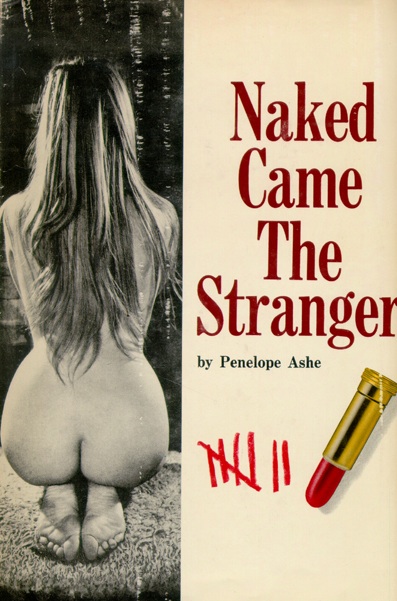
In 1968 a relative of McGrady's posed as new author Penelope Ashe marketing "Naked Came the Stranger" as her first novel. The book sold to the first major house she
approached and was published in 1969, becoming an instant bestseller (the picture of the naked woman on the cover probably helped). Book reviewers in major markets, including Stern, Le Monde, and the New York Times, used phrases like "sizzling" and "thought-provoking" and compared the ersatz Penelope Ashe to John Updike and Philip Roth. She appeared on talk shows, was interviewed about sexual liberation in women's magazines, and advised aspiring writers to impale themselves on their typewriters. After a few months the authors appeared en mass on the David Frost Show, explaining their reasons for the hoax and expressing some embarrassment that their intended pillory of "sex sells" novels was now outselling its competition. The revelation of the hoax actually triggered a jump in sales fueled by widespread speculation the novel was in fact a roman-a-clef and that the adulterous men in the Long Island community were nationally known public figures.

Naked Came the Stranger is more fun to read about than it is to read. In fact, reading it is a chore. Not only are the mores of the period awkward by today's standards, the book itself is deliberately and methodically awful. Oh, there are moments. Like when Gilly asks a pornographer where he gets all his kinky ideas and he replies: "Like every other writer, I draw from the human condition." But on the whole, McGrady did a thorough job of eradicating anything of value from the manuscript.

Naked Came the Stranger was a bestseller not because of its excellence, but because people will read what they want to read despite what any arbiters of literary taste say or gatekeepers of excellence do. And "gatekeepers" includes the band of hoaxers who were sounding the alarm about the degeneration of American literature. The trend they were protesting matured, outgrew its "look what we can get away with" stage, and diversified into the spectrum of spicy, sensuous, and erotic romance novels that today makes up the lion's (lioness's?) share of the world fiction market. All of which says a lot about the role of traditional publishers, and the potential future of independents.

(More about Naked Came the Stranger in Museum of Hoaxes and Wikipedia)


Saturday, December 15, 2018

The One Writing Rule You “Must” Follow

Novel Spaces is in its 10th year! Over the coming months we'll be featuring some of the most popular posts from our archives. This one was first published August 11, 2010.


By Charles Gramlich

I hear a lot of advice about writing. I listen to it all, though I don’t necessarily take it all. Here are some of the “rules” I’ve picked up over the years:

Show don’t tell.
Kill your darlings.
Avoid adverbs.
Never use clichés.
Ain’t ain’t a word.
Avoid Info Dumps.
Conflict on every page.
Use adjectives sparingly.
Don’t split infinitives.
Character trumps plot.
Avoid “ing” endings.
Never a day without a line.
Don’t open with description.
Never write in second person.
Don’t start sentences with “and” or “but.”
Characters must change during a story.
Dialogue should do more than one thing.
Develop a full biography for each character.
Never repeat salient words close to each other.
Use active rather than passive sentence structure.
The first word that pops into your head is the best word.
Always begin a story with people talking to each other.
Know every element of your story before you start writing.
Children and animals are naturally sympathetic characters.
Avoid authorial intrusions (Direct address from author to reader).

The truth is that none of these are rules. At best they are guidelines, and at worst they are straightjackets. The one absolute rule of writing is that there are no absolute rules. “Show don’t tell” is a good guideline but you can’t always follow it literally or your work would be unreadable. When you’re moving characters around in a story but the travel itself isn’t important, just tell it and get it done. The rule really means to “show” the interesting stuff. Otherwise your work will be weighed down with useless detail.

Never start a sentence with “and” or “but” is a bad rule. Sometimes those are perfect to start sentences with. Note every sentence, of course.

Never begin with description might be a good rule but it’s one I refuse to obey. I often start with description, and, for me, I hate, hate, hate books and stories that start with dialogue. I almost always put them down immediately.

Never use clichés is both a good and a bad rule, depending on the situation. Cliché description, like “red as a rose,” or “free as a bird,” is generally weak because readers have seen the phrasings so much that they don’t really process the meaning. However, sometimes having a character speak in clichés is just the right element to bring your story to life.

“In media res” is generally a good rule, I think, but it also depends on the genre. It’s a critical rule for thrillers, but not nearly as necessary in literary fiction. And when someone tells me to “never use adverbs” I counter with “never throw a tool out of your tool kit.”

One of the best things about writing, and one of the most intimidating, is the incredible freedom it affords you to do and say whatever you want. Certainly, you should listen to the advice of others. I’ve given plenty of advice myself, and I think it has been good advice. But don’t let anyone fool you into believing that guidelines are rules. It just ain’t so.

So, tell me, what are some of the other “rules” of writing that aren’t really rules? What have I missed?


Saturday, December 8, 2018

Must-See TV for Writers

Novel Spaces is in its 10th year! Over the coming months we'll be featuring some of the most popular posts from our archives. This one was first published January 21, 2018.  


By Maggie King

As a writer, I love TV shows that use intricate plots and settings to show the ups and downs of being human in a less-than-perfect world. As a crime writer, I am especially fond of shows in the mystery genre. Regardless of the genre, the best TV features conflict as a common denominator.

The following are my top picks:

Cast of As Time Goes By from BBC
As Time Goes By (1992-2005) was a BBC-produced romantic comedy of manners about Lionel and Jean, who were lovers in their youth only to be separated due to a communication failure (communication issues dog every relationship, don’t they?). But they meet up again thirty eight years later and resume their relationship, in fits and starts.

As Time Goes By portrayed well-drawn characters in relationships that were very real. The humor was natural and not manufactured. Lionel and Jean loved each other, despite occasional minor conflicts. My husband and I share the same affectionate marital banter that Lionel and Jean enjoyed. Their story has gladdened the hearts of romantics everywhere.

I try to emulate this tone and interaction for my characters. Most stories have a romantic component and my Hazel Rose Book Group mysteries are no exception.

Beck is a Swedish police procedural, based on the novels of Maj Sjöwall and Per Wahlöö. The characters are sharply drawn, from the plodding, methodical Martin Beck to his hot-tempered, politically incorrect partner, Gunvald, a loose cannon if ever there was one. The writers allow the characters to grow throughout the series, giving them plenty of opportunities to reveal their humanity, warts and all. There is violence, especially when Gunvald gets involved, but it’s not on a par with the Girl with a Dragon Tattoo series.

Writers can learn much about creating riveting stories and compelling characters from watching Beck.

Downton Abbey Talk about conflict! This acclaimed British period drama revels in it. It’s educational to see how the fast-paced stories keep us glued to our seats. The secret, I believe, is to supply each character with back-to-back personal challenges, whether they be related to money, marriage, death, birth—the list goes on.

Midsomer Murders Don’t be fooled by the idyllic-looking county of Midsomer—its murder rate beats that of any urban area. Passions run high and evil lurks everywhere. Midsomer Murders is a slightly quirky British detective drama based on the crime novels by Caroline Graham. The main characters enjoy satisfying relationships, and the guest characters tend to be eccentric and harbor pasts (and often presents) ridden with secrets and scandals. They are often involved in the arts, academia, and the occult: painters, actors, writers, professors, fortune tellers, etc.

I especially liked the episode “Written in Blood,” where murder took place in a writing group.

Miss Marple Ah, the beloved Miss Jane Marple, created over eighty years ago by Agatha Christie. The elderly spinster lives a quiet life in the village of St. Mary Mead—quiet until a villager is murdered and that happens with alarming regularity. Miss Marple nails the murderer(s) every time, using her powers of observation. Sometimes she disguises her shrewdness with a dithery manner. Living in a village, she is well-acquainted with the vagaries of human nature, and she can always draw a parallel between the latest crime and a villager, or village incident.

There are countless adaptations of the stories and a number of actresses have played Miss Marple. Joan Hickson is my favorite as she best matches my picture of how the character looks, acts, and speaks.

Agatha Christie has influenced many crime writers over the years, especially with plot development. I expect that she’ll do so indefinitely. I think the Columbo character played by Peter Falk often channeled Miss Marple, with his bumbling ways that concealed a sharp mind.

From Wikipedia
Taggart, one of the UK’s longest-running series, is an unflinching police drama from Scotland. I rent the DVDs from my local library. The story lines are intricate as are the personal relationships of the recurring and guest cast members. I enjoy the depictions of the relationships, many of which are unenviable and riddled with friction between characters who are far from perfect. Twists and turns in the plot culminate in the killer, or killers, being identified. More often than not the end comes as a stunning surprise.

These gritty stories are set against Glasgow’s grand architecture.

In my estimation Taggart is a must-see show for crime writers.

Touched by an Angel was a popular American series that ran for nine seasons. I’ve long been attracted to stories of people who have reached turning points in their lives. Sometimes they’re between a rock and a hard place. As they’re grappling with personal demons, conflict, and tough choices, along comes an angel in human form to guide them and impart God’s wisdom.

This show inspired me on many levels. At the beginning of my debut mystery, Murder at the Book Group, the main character, Hazel Rose, is standing at a crossroads. She is at loose ends in her life and is hard pressed to make even the smallest of decisions. Solving the victim’s murder gives her the opportunity to grow and get out of her rut.   

Writers can get inspiration from many more great shows: Brokenwood, Janet King, Inspector Morse, Maria Wern, Wallander, West Wing, and Winds of War/War and Remembrance are just a few.

Tell us your favorites.