
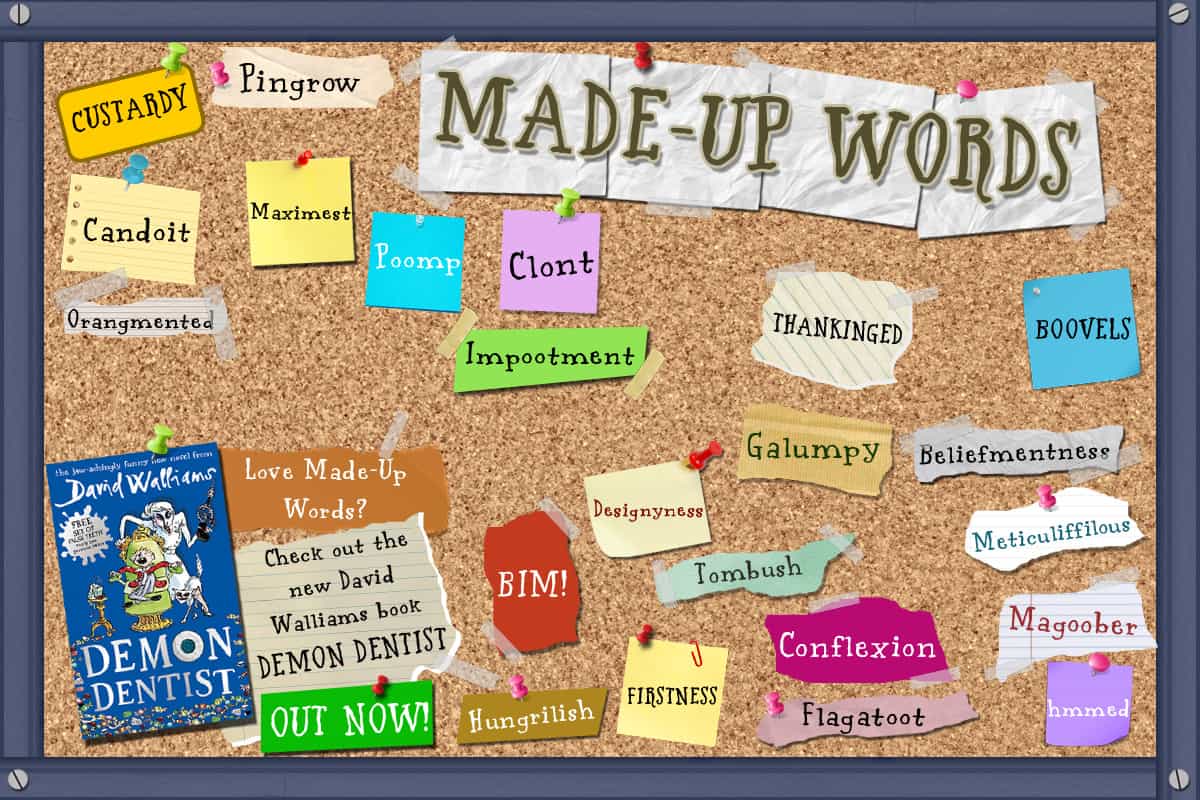
 Made up words. Every family has them—or so I believe. They are words commonly used among family members that are believed to be legitimate English words but are not found in any dictionary. Some of them may be bona fide English words but may be used in a different context to common uses. Others may be common items but called by a specific brand name rather than the common name. Sometimes these pesky words sneak into our writing unwittingly.
 My family is fraught with them. My father was a carpenter who always referred to formica by its brand name, Arborite. One day he sent me to the store to purchase some Arborite. As soon as I asked the shopkeeper for Arborite, he said, “You’re Lloyd’s daughter aren’t you? He’s the only person on the island that calls formica Arborite.” That was the first time I realized my family had its own unique diction.
The second time took me a little longer. We grew up referring to movie trailers as “draphic.” I had no idea that it was not a legitimate word until I went to graduate school. I was talking to a lab tech about the draphic to a movie and she had no idea what I meant. When I explained the meaning to her she said there is no such word. I challenged her. We looked it up using many resources at our disposal, and I lost. There is no such word as draphic. Of course I had to be conceited, so I defended my position by saying it is a Kittitian word. I’ve since then spoken to a lot of Kittitians about the word. The only people who know what it means besides my family are friends of my family who frequented our home.
I started looking up a lot of the words that we commonly used in my family vernacular and yes, many of them were not real English words, but still, they sometimes creep into my writing unwittingly.
Take for example the word spall. According to Merriam dictionary, as a noun it means a small fragment or chip and as a verb it means to break off or chip. In my family, and maybe on a broader level, my island, it had a very specific definition that was restricted to eroded enamel utensils. If an enamel cup or plate had an eroded spot where the paint was chipped and we could see the rusting metal beneath, we said it was spalled or spalded or spall up. And if you dropped a perfectly good enamel utensil you could “spall it up’. In writing my latest romance, “Hurricane of the Heart” to be released this summer, I described an enamel plate as being spalled. My publisher/editor asked what it meant. I found it perplexing that she was from the Caribbean, from the same country as me and had never heard of a spalled or spalded or spallup cup. So we looked it up. Eventually I realized though the word spall is used to mean chip, there is not “spalled” or “spalded”. We eventually changed the word to tarnished.
I’m sure it’s not only my family that mangles English words with so much reiteration that the members accept them and their usage as standard English. What are some of the unique words in your family or cultural vernacular that you thought were Standard English? Do they ever creep into your writing and if so does it enhance or adversely affect your writing?
I want to wish Novel Spaces a happy 6th anniversary today.
Write on, novelnaughts, write on!


